
When working outside, I end up using a lot of different surfaces and not all are ideal for making children’s work stand out or to play games.. A stock item in my bag is an old white sheet. I have various sorts and sizes from king-size (ideal for whole class work) down to cot-size (for pairs or individual work). I use them deliberately to highlight natural materials.
I’d love to be able to tell you this was my bright idea, but white sheets have always had their place outside, In my days as a seasonal ranger, we often used white sheets for hunting little creatures or hung a sheet up to play shadow games, However when I was in Sweden in 2008, the early years practitioners showed me how useful they were for many nature games. I realised they had maths potential too which I guess is my contribution to the wider collective knowledge.
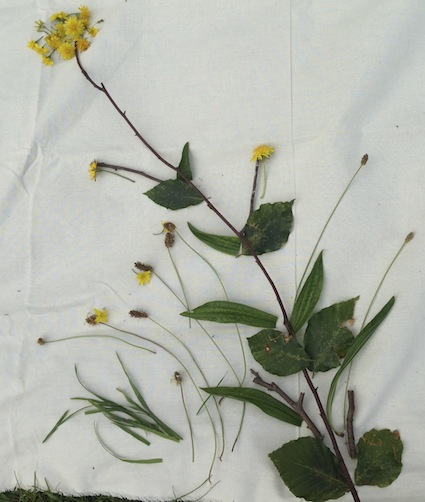
Without a plain backdrop, often the beauty and detail of a design can be lost. Or children simply cannot see what you are trying to show them.
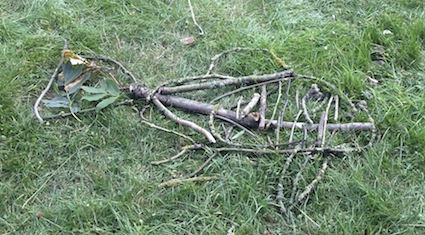
The sheets are very prone to getting wet and muddy. I try not to wash them unless absolutely necessary, otherwise I think my washing machine would be constantly on.
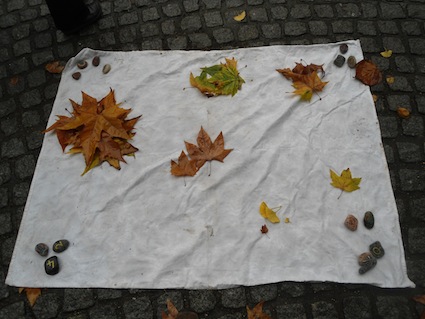
For really foul weather, I flip to plastic sheets. In the photo below, I have used magic whiteboard sheets. When I purchased these many years ago, I thought they wouldn’t last long outside. They seemed really flimsy. Over the years, I’ve found they lose their static and are no longer ‘magic’ in terms of sticking to walls. The sheets have grown thicker and tougher and have become more robust with age.
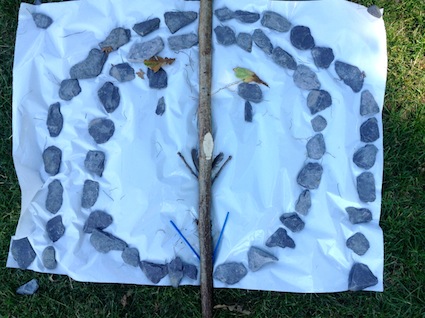
I see many practitioners sticking to blue tarps. Whilst I understand their functionality in damp or wet weather, a cotton white sheet that highlights the aesthetic qualities of natural materials. Furthermore, as Bruner advocated, we need to support children in making connections between concrete, pictorial and abstract representations of materials. As you can see in these photos, a child lays the (concrete) materials on the sheet. The creamy white background looks like a sheet of paper. When you take a photo, it becomes a pictorial representation. When reflecting on the work we can develop children’s abstract thinking.
I find on windy days, either the plastic or the cotton sheets do need weighted down at the corners. In fact, sometimes, this adds an additional problem solving element to any activity!
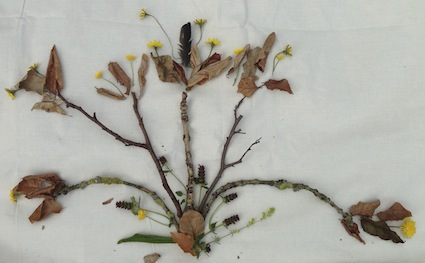
The only other thing worth remembering is that on snowy days, a white sheet is simply not needed! Bring on the winter weather!















Great idea! I bet so many people threw those whiteboard sheets out when they became exactly how you want them to be!
Yes – any material works well. Aesthetically I find creamy white most easy on the eye. The other good colour can be black.
Love white sheets! In early summer, I hang ours in front of our porch lights at the school and the next morning, bingo!, loads of moths and beetles to investigate before they fly off later. This past summer I also found painter’s drop clothes useful because they are plastic-backed. The children used one (5’x5′) to make a collaborative map of our forest area. It held up to watercolor, oil pastels, and latex paint AND getting dragged around inside and out.